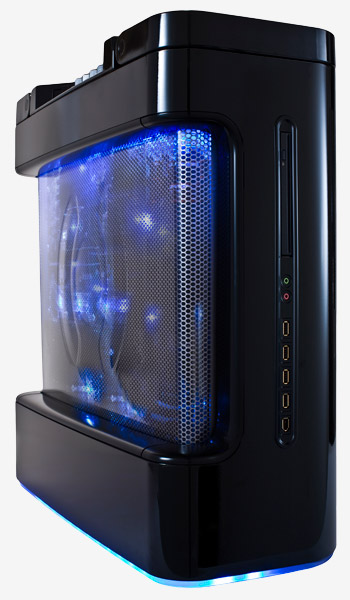
$9K Liquid Cooled Gaming Rig Makes Big Splash
The ancient art of overclocking is more delicate ballet than exact science. The goal is to force your hardware to perform at much higher speeds than the manufacturer intended, while compensating for the immense amount of heat generated — heat that can cause system instability, and ultimately deep-fry your PC's innards. Beat the heat and your overclocked PC will frag faster and live longer.
This usually means air-cooling with loud fans, water-cooling, or some combination of the two. Hardcore Computer is trying something a bit different — submerging all of the fancy, expensive PC components in 4.5 gallons of industrial cooling fluid.
This is the DNA that makes up the Reactor PC. Weighing in at just over 100 pounds, this behemoth is clad in 2.5 mm of aircraft aluminum. The tank that contains the fluid is comprised of a plastic similar to a NASA astronaut's visor, plus it's bullet proof, should your gaming lair come under small arms fire.
We received a Reactor test unit packed with variety of high-performance parts, including an Intel Core 2 Extreme processor overclocked to 4 GHz, 4 GB of ram, and three 64-GB solid state drives for wacky-doodle fast (and expensive) data-transfer rates.
Gamers will be interested in the slot loading DVD burner (or optional Blu-ray reader), and the three Nvidia GTX 280s running in SLI. In addition to seeing impressive scores on benchmarking software, we ran the all-important Crysis test, and saw an average of 40 to 45 frames per second with every setting pumped to the absolute maximum. And there's still room to push the pre-overclocked components even further.
For the tinkerers, haxz0rs and IT-minded in the audience, the Reactor is built with high-performance server-grade technology in mind. This includes a pair of 650-W power supplies that provide a total of 1300 watts of juice, plus redundant backup — if one dies, the other will keep on churning. A pair of hot-swappable drives, weighing in at 1 TB each, let you switch your battle plans out for family vacation videos without ever shutting off your PC. Wifi is even built in, complete with two funky antennas that would normally be considered eyesores but somehow look right on the rig.
A substance called Core Coolant is the bloodstream of this gaming monolith. It's a biodegradable, dielectric, non-toxic cooling oil created by Hardcore Computer, and it's is responsible for chilling your key components. Like the typical liquid-cooled setup, a pump circulates the fluid through the Reactor's chassis and into a radiator, where the warmer fluid is made frosty and sent back into the tank.
The key difference between an air- or water-cooled setup and the Reactor is unparalleled heat transfer: You can overclock every piece of your machine without fear of a catastrophic burnout. Fans are positively archaic; air simply can't disperse the amount of heat generated by a gaming rig — it's often in the area of 158 degrees F. Liquid-cooled systems are more efficient, but while the maze of tubes might draw heat from the CPU and graphics cards, plenty of other thermal-generating components are left at risk, typically resulting in system instability.
Submerged cooling isn't perfect. The most obvious issue is the size and weight of the thing, with 4.5 gallons of fluid sloshing around in there. And no matter how careful you are, you'll want to keep a roll of paper towels handy, because there will be a bit of unavoidable splashing when you inevitably pop the lid and start poking around inside the machine. Luckily, Core Coolant (which is clear, odorless, and has the consistency of mineral oil) is safe enough to drink, according to the company. (Please don't drink the Core Coolant.)
But the biggest caveat with the Reactor is that you're buying into an ecosystem. While many of the components can be swapped with off-the-shelf parts, the motherboard and power supplies are packed into custom shells. That means when you want to upgrade the motherboard (maybe to check out that nifty Core i7 CPU from Intel) you'll have to contact Hardcore Computer directly to pick out a new one.
And finally, there's the price.
The configuration we tested came in at a hefty $9,790. But the models start at a reasonable $3,670.
How is that reasonable? A bit of painstaking calculation (method: Google + newegg + napkin) reveals that the DIY price for the components in the starter model comes to roughly $1,000. Essentially you pay about $2,700 for service, a warranty, Core Coolant and a chassis that will support a substantial amount of abuse, overclocking and general tinkering. With the right amount of research, a savvy enthusiast could customize a build to fit their budget and overclock individual components until their performance dwarfs far more expensive machines.
But really, outside of a few supercomputers and aquarium tanks filled with mineral oil, we can almost guarantee you'll be pressed hard to find a PC like this anywhere else.

For more photos of the Reactor PC, inside and out, check out our photo gallery: Soak It To Me: Inside Liquid-Suspended Gaming PC
WIRED Unsurpassed overclocking performance. High quality components at a price that's semi-reasonable. Those LEDs are optional.
TIRED Weighs as much as a '72 Buick and is twice as ugly. Potentially very messy — don't spill Core Coolant on tile floor, it gets slip 'n' slide slick. If Hardcore Computer ever flounders, how will you upgrade those custom parts?
Processor: Core 2 Extreme QX9770 Power Supply: 2 650W Server Grade PSUs RAM: 4GB of DDR3 Graphics Card: 3x Nvidia Geforce GTX 280 in SLI Hard Drives: 2x Samsung 1TB Spinpoint F1, 3x Samsung 64GB SSDs OS: Vista Ultimate